No fluff. No fads. Deep-dive investigative reports from the surgeon who actually sees the inside of the joints.
If your MRI said "rotator cuff tear," your surgeon's plan should depend on the exact tendon involved, its retraction, the muscle quality, your age, and your sport. Not on a default technique.
The rotator cuff is a group of four muscles — supraspinatus, infraspinatus, teres minor, subscapularis — whose tendons fuse into a single cuff that wraps the humeral head. Each tendon has a job: elevation, external rotation, internal rotation. When a tear starts, it is almost always in the supraspinatus, then propagates posteriorly or anteriorly.
The decision is not "repair or not." It is "repair now, repair plus augment, or replace the strategy altogether." All three are right — for different tears.
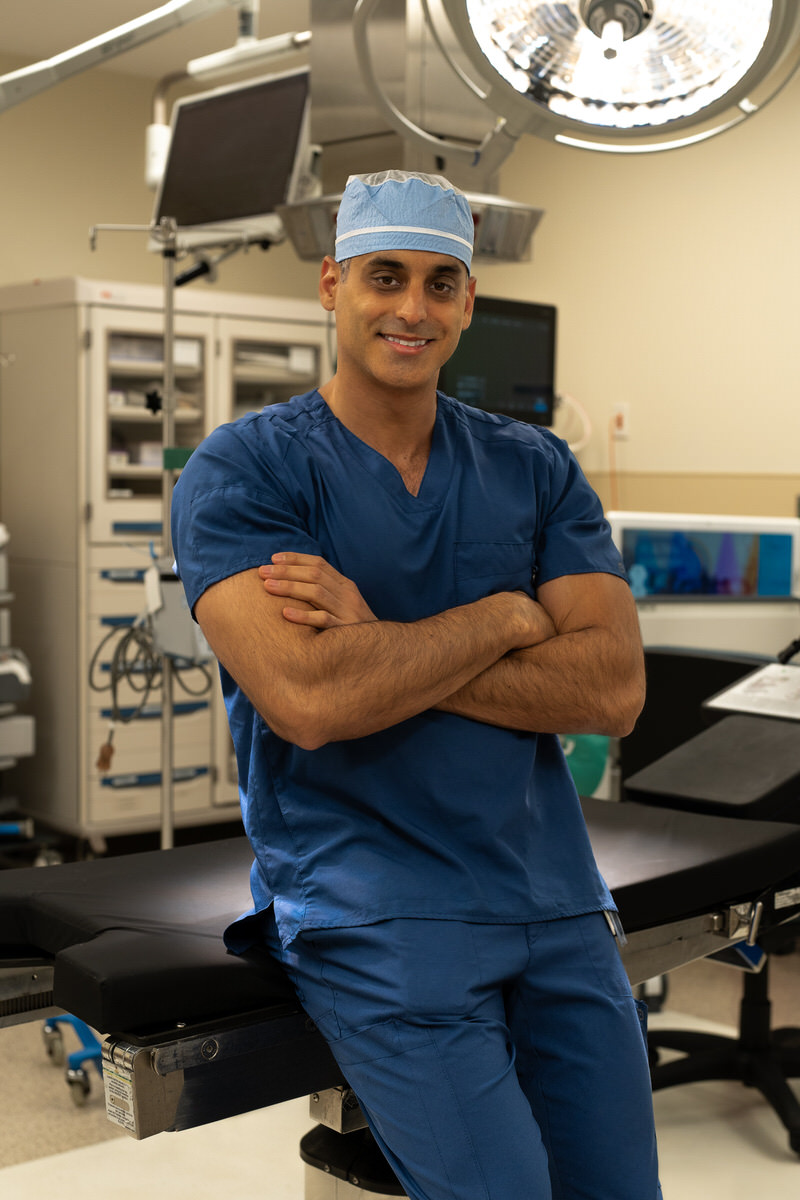
Dr. Sameh Elguizaoui, M.D. — Board-Certified Orthopedic Surgeon, Fellowship-Trained in Shoulder ArthroscopyA partial, non-retracted supraspinatus in a 45-year-old is a different animal than a retracted, fatty-degenerated massive tear in a 72-year-old. Both are "rotator cuff tears." Only one gets a straightforward repair.
For most repairable tears, double-row arthroscopic repair is the gold standard. It uses two rows of bone anchors to press the tendon flat against a wide footprint on the humerus — a construct that restores the native tendon-to-bone compression and heals more reliably than a single row.
Three small portals, a camera, and a full look at the joint. Labrum and biceps are evaluated; hidden tears are mapped.
The bone is gently abraded to bleeding cancellous surface — marrow elements seed the repair with growth factors.
Two medial anchors secure the tendon at its articular edge. Sutures are passed through the tendon and tied down laterally onto a second row of anchors — the transosseous-equivalent construct.
For high-risk tears we add a dermal allograft patch over the top to shield the repair and add scaffolding. In our hands, this cuts re-tear rates for large tears meaningfully.
Some tears cannot be pulled back to the bone. The tendon has retracted too far, the muscle has atrophied, and forcing a repair will simply fail — often within six months. For these tears in patients too young for a reverse shoulder replacement, SCR is the elegant alternative.
The technique uses a thick dermal allograft to reconstruct the superior capsule. It does not replace the torn tendon — it restores the ceiling of the joint, preventing the humeral head from riding up into the acromion. Pain goes down, strength improves, and the arthritis trajectory slows.
Repairable
Irreparable but Young
If you are over 65, have a massive tear with fatty muscle, and have already developed cuff-tear arthropathy, the best answer is almost always a reverse total shoulder arthroplasty. The deltoid takes over what the cuff can no longer do. Outcomes in the right patient are excellent.
An MRI is only half the story — book a cuff-tear consultation to map tear size, retraction, and muscle quality into a repair plan you can actually recover from.Small, non-retracted, asymptomatic tears in sedentary patients can be observed with PT. Symptomatic tears progress — and tears that progress become harder to repair. Early treatment protects the window.
The tendon is reattached to the bone with sutures and anchors — but biology does the actual healing over 12 weeks. Protecting the repair in a sling is the single biggest driver of whether it holds.
Biologic augmentation is being studied; small effects have been shown in specific patterns. It is not a replacement for surgery when there is a full-thickness retracted tear. Read our PRP deep dive for the evidence landscape.
For most arthroscopic repairs, 90–120 minutes. Outpatient, same-day discharge, usually under a regional block so opioid use is minimal.
New onset of weakness, loss of motion, or night pain between weeks 6 and 16 are the red flags. An MRI and a clinical exam answer it.
Get Started
Take the first step toward recovery. Schedule a consultation with Dr. Elguizaoui to discuss your condition and explore your treatment options.