No fluff. No fads. Deep-dive investigative reports from the surgeon who actually sees the inside of the joints.
If you have been told you need a shoulder replacement, the next question is not when. It is which one. Two implants share the same name and almost nothing else. Picking the right one is the single biggest predictor of whether you will lift your arm overhead a year from now.
Unlike the hip or knee, the shoulder is not stabilized by bone. The humeral head is a giant golf ball balanced on the tiny tee of the glenoid, held there almost entirely by the rotator cuff — four muscles whose tendons blend into a single envelope around the joint.
This matters for replacement. A hip can tolerate a weak abductor and still work. A shoulder with a torn, retracted rotator cuff cannot use an anatomic replacement at all. The biology of the soft tissue dictates which implant belongs in the body.
The question is never whether to replace the shoulder. It is whether the rotator cuff is still doing its job — because that one sentence decides which operation you get.
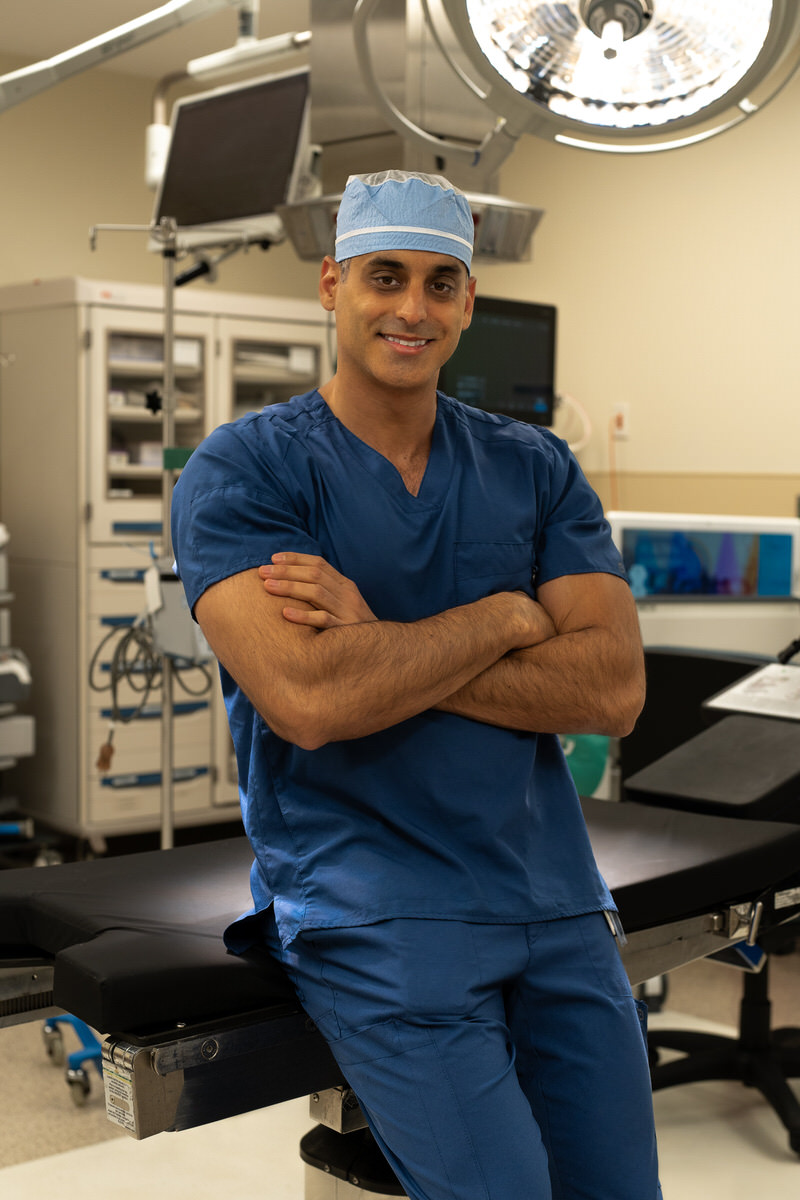
Dr. Sameh Elguizaoui, M.D. — Board-Certified Orthopedic Surgeon, Fellowship-Trained in Shoulder ReconstructionAn anatomic total shoulder arthroplasty replaces the worn surfaces without changing the mechanics. A polished metal ball goes on the humerus, a plastic cup is cemented into the glenoid. The geometry mimics the native shoulder — hence anatomic.
The arthritic humeral head is cut and replaced with a cobalt-chrome ball sized to match native anatomy within 1 mm.
A polyethylene component, sometimes with metal backing, is fixed into the prepared glenoid. Modern glenoids are guided by 3D CT-based planning and custom instruments.
The rotator cuff is protected throughout and is the engine that drives elevation after surgery. If the cuff cannot move the joint, the implant cannot move the arm.
Reverse total shoulder arthroplasty flips the ball and socket. A metal ball is fixed to the glenoid; a plastic cup sits on top of the humerus. The geometry is now constrained, and the deltoid — not the rotator cuff — becomes the driver of arm elevation.
It sounds bizarre. It works brilliantly. The French orthopedist Paul Grammont designed it in the 1980s specifically for the patient the anatomic shoulder had failed: the person with a massive irreparable rotator cuff tear and an arthritic joint.
Cuff intact
Cuff deficient
After an anatomic TSA, yes — most patients return to both within 4–6 months. After a reverse, golf is common by 4 months; tennis and heavy overhead sports are generally discouraged because of implant wear at extreme elevation.
Modern implants routinely survive 15–20 years. Younger patients (< 55) with high activity demands may face a revision in their lifetime, which is planned for at the time of the index surgery.
Infection is low (~1%) but serious. In the reverse shoulder, scapular notching (bone erosion against the polyethylene) was the historical concern; newer implant geometries have dramatically reduced its frequency.
Yes. CT images the glenoid bone stock — the most important variable in implant choice and positioning. A 3D CT is the foundation of a patient-specific plan.
Some patients fall into a gray zone. Intraoperative assessment of cuff quality can change the plan. That is why your surgeon should have both anatomic and reverse trays open in the room — and the training to use either.
Get Started
Take the first step toward recovery. Schedule a consultation with Dr. Elguizaoui to discuss your condition and explore your treatment options.